
You finish worrying about a work deadline and immediately start thinking about a bill, a family member or something you said yesterday. Even when nothing urgent needs your attention, your mind finds another possibility to investigate. Generalised anxiety disorder, usually shortened to GAD, can feel like this: worry moves between different areas of life and is difficult to put down. From the outside you may look organised and capable, while privately feeling exhausted by how much thinking it takes to get through an ordinary day.
I offer hypnotherapy for generalised anxiety disorder at AbsoluteU in Horsham, near Crawley, and online. Our work focuses on your relationship with persistent worry, including the checking, mental rehearsal and repeated reassurance that can keep it going.
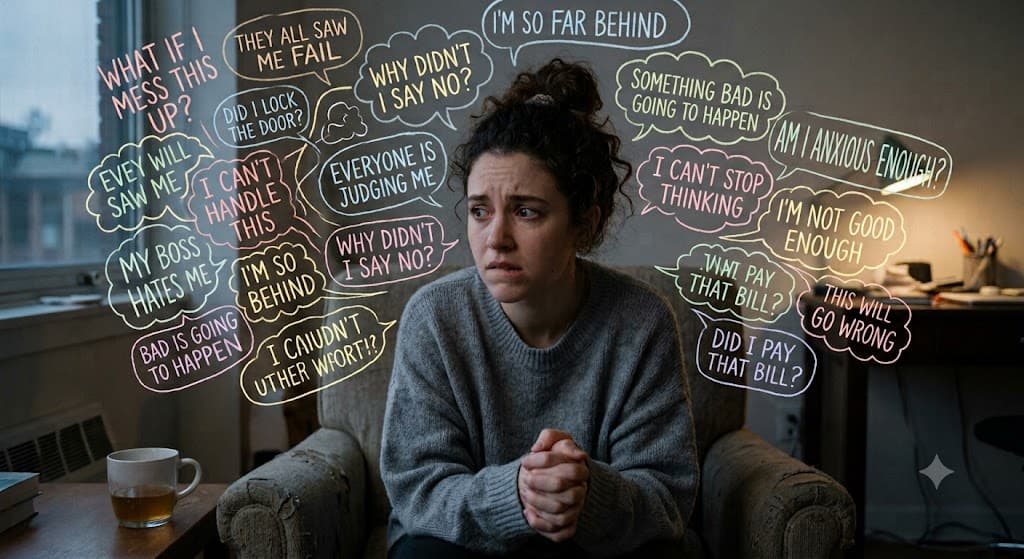
You do not need to arrive with a perfect explanation of why you feel this way. We can begin with what happens in your daily life and what you would like to be different. For a broader overview, see how I use hypnotherapy for anxiety.
When worry becomes the background to everyday life
Ordinary worry usually has some connection with a problem you can address. You make the phone call, deal with the deadline or wait for the result, and your attention gradually moves on. With GAD, reassurance often has a short life. An answer may settle one question while another appears: what if something was missed, what if the plan changes, or what if you cannot cope when the time comes? The difficulty lies partly in the amount of time worry occupies and how hard it feels to stop.
You might lie awake revisiting tomorrow, struggle to concentrate because several concerns are competing for attention, or feel tense and irritable without knowing which worry started it. Rest can become uncomfortable because being busy is one way of keeping the thoughts at a distance. These experiences deserve attention, but a checklist cannot diagnose GAD. If anxiety is persistent or affecting your ability to function, a GP can assess what is happening, including whether physical symptoms need investigation.
The difference between planning and going round in circles
Worry can feel responsible. If you keep thinking through every possibility, perhaps you will prevent a mistake or avoid being caught unprepared. That makes stepping away feel risky, even when you can see that the thinking is leaving you more unsettled. A useful distinction is whether the thought leads to a practical next step. Checking a renewal date may solve a problem; replaying every possible consequence of overlooking it usually leaves the uncertainty intact.
In sessions we can look at this distinction without criticising you for worrying. We might explore what happens when you have done enough preparation, but still feel driven to check once more. The aim is to recognise when problem solving has turned into repeated mental checking, and to practise responding differently. Some uncertainty will remain. Building confidence in how you respond to it is more useful than trying to obtain an answer to every imagined scenario.
How I work with persistent worry
My wider approach to anxiety combines hypnotherapy with CBT techniques and, where useful, NLP methods. With GAD, the emphasis is on your particular worry patterns: when they begin, what you do to feel safer, and what happens afterwards. Hypnosis offers focused time to work with anxious expectations and rehearse a more measured response. You remain aware and able to tell me what is comfortable or unhelpful throughout the process.
Practical work may include noticing the difference between a possibility and a probability, reducing repeated reassurance, and experimenting with leaving a small decision settled. We can also work on the tension that makes worry feel urgent and on ways of winding down that suit your routine. The approach should fit your circumstances. Someone juggling real financial pressure needs room to address that situation, as well as help with the extra layers of anticipation around it.
Between appointments, we may agree a manageable piece of practice, such as noticing one repeated worry or using a brief self hypnosis exercise. This is something to learn from, rather than another task to perform perfectly.
What the evidence can tell us
CBT has an established evidence base for GAD. NICE guidance recommends CBT or applied relaxation when a high intensity psychological treatment is appropriate. Evidence for hypnotherapy in diagnosed GAD is less established. If you have a diagnosis, take medication or already see another professional, we can discuss how any additional support would fit with your existing care.
A 2019 meta analysis of hypnosis for anxiety reported benefits across the studies it included, with stronger results when hypnosis was combined with other psychological interventions. That is encouraging general evidence, but it does not establish the effectiveness of my particular combination of methods for GAD, or predict how many sessions an individual will need. We will judge our work by the changes that matter in your everyday life.
We review your response together and adjust the work when needed. Progress might mean spending less of the evening inside a worry, making an ordinary decision more easily, or returning your attention to a conversation instead of mentally preparing for tomorrow.
One client described it as finally being able to sit in the garden without her mind immediately jumping to everything that needed doing. “I had forgotten what it felt like to just be somewhere,” she said. Small moments like this are often the first signs that something real is shifting.
Frequently asked questions
They can overlap, but the terms describe different things. GAD involves persistent worry across a range of subjects and requires a clinical assessment for diagnosis. Fear of the unknown may centre on a particular change, unanswered question or decision. You can experience difficulty with uncertainty without having GAD.
We need enough understanding to work safely and usefully, but we do not have to work through an endless list of hypothetical problems. Often it is helpful to examine a few examples closely and notice the repeated response beneath them. I will also make space for real difficulties that need a practical answer or another kind of support.
There is no reliable number that applies to everyone with GAD. We will discuss your circumstances, agree what you want to change and review progress. You can find current appointment lengths and options on the professional fees page. A package provides a booking structure, rather than a guarantee of a particular outcome.
Support in Horsham and online
If persistent worry is taking up more of your life than you want, you can contact me to discuss whether this approach would suit you. Appointments take place at Roffey Park Institute in Horsham, convenient for Crawley and the surrounding area, or online. A free initial telephone consultation gives us an opportunity to talk through your questions before arranging therapy.